
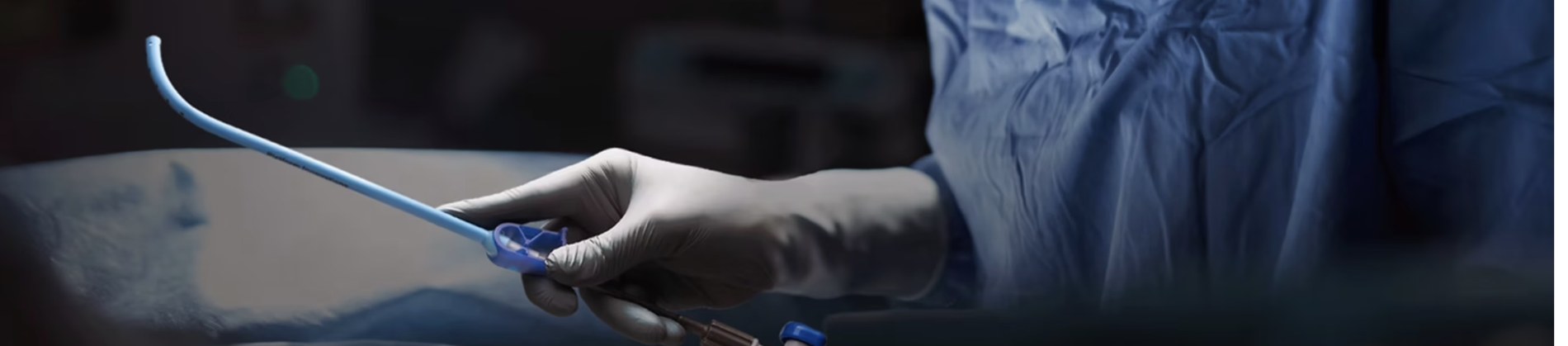
Where the adjustable curve helps surgical teams reach what rigid suction can't — across colorectal, gynecologic, thoracic, and urologic procedures.
The adjustable curve lets surgical teams maneuver around anatomy and instrumentation to address bleeding or pooling directly — improving visibility and unobstructed access to critical dissection planes.
ACSIS can articulate over the sacrum and into the deep pelvis without obstructing the surgeon's field of view and instrumentation.
ACSIS provides access up through the crus of the diaphragm and into the hiatus to deconflict with anatomy, field of view, and instrumentation to clear fluids.
ACSIS articulates around ligaments and the curvatures of the uterus and fundus to address fluids without blocking visualization and instruments.
ACSIS helps to efficiently visualize dissection of the attachment point for the mesh at the sacrum, as the sacral prominence often blocks straight metal suction from clearing fluid down into the cul-de-sac. Articulating the ACSIS tip can deconflict with instrumentation and prevents obstructing the field of view during dissection of the vagina for mesh placement.
ACSIS's articulation provides access to fibroids, fibroid dissection planes, cysts, and cyst walls where straight rigid suction devices are blocked. Post-procedure, ACSIS enables fluid to be completely cleared from the cul-de-sac.
ACSIS provides access to dissection planes while articulating around hard lung, tumor tissue, adhesive rind, and great-vessel anatomy without obstructing the field of view and instruments.
ACSIS enables suction irrigation access over the kidney to address the upper or lower pole lateral border.
ACSIS can efficiently address bleeding or pooling fluids in the lateral gutters or around the apex while avoiding the surgeon's field of view.
ACSIS can articulate over the sacral prominence and addresses pooling that is distal to the prominence.
Model annual savings, ROI, payback, and risk mitigation with the interactive ACSIS calculator.